 ÁKROS
ÁKROS
ÁKROS
ÁKROS
 ἄκροςTechnical expertise
Train, design, equip — on stage, at events or on film sets. Our first craft: taking performers, dancers or otherwise, into aerial work, acrobatics, stunts or stage combat, and preparing them all the way to the performances. Then the act itself: placing the acrobatics, setting the stunts and the fights, designing human flight, working in 3D and proposing the staging changes that go with it. Case by case, with a plain view of what works — and what does not.
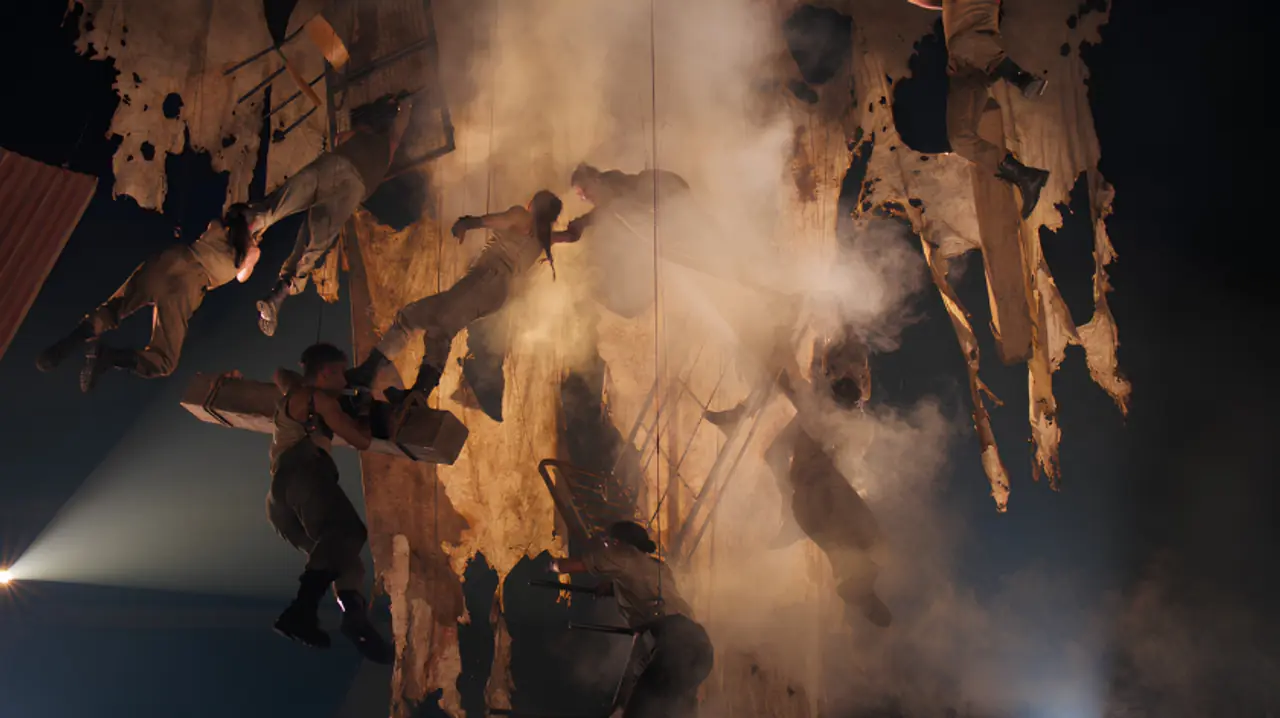
The Rise — RB Dance CompanyStudy, design, safety, delivery: we help productions, companies and project leaders shape what they want to do — and we think through every detail beforehand so there are no surprises on the day.
Our first craft. Artists, companies, productions, events: when a project calls for aerial work, acrobatics, stunts or stage combat, we bring the performers — dancers or otherwise — up to what the project demands. We set, we rehearse, we make it safe, until it's clean and safe on stage.
What happens on stage, and what makes it possible: placing the acrobatics, writing an act and choosing the apparatus, setting a stunt and its landing, choreographing a fight. And the rigging itself: our rigging is human flight (not lighting or sound — people and apparatus). We tell you where and how to fly; structural validation of the anchors belongs to an engineer or a structural consultancy.
Landing mats, flight gear, winches, aerial motors, hardware, tripods, pole-dance stages: our inventory goes out on hire, tracked and documented. And our 250 m² studio in Mouchamps — six aerial rigging points, one motorised — is bookable for residencies: dance, circus, stunts, research and creation.
Every request comes with its own venue, performers, dates and budget. We look at what it really involves, then propose what holds.
We place the acrobatics inside the act, the tableau, the scene: what is seen, when, in what space. Lifts, jumps, falls, landings — set and rehearsed with your performers.
Silks, straps, hoop, rope, trapeze, net: we write the act, choose the apparatus that suits the story you are telling, and build the sequences.
Where to fly and how to get there: the path, the take-off and landing heights, the speed, the forces at play — and what it asks of the person flying. We draw the flight, build the system, load-test it.
We design and set the stunt with the people who will perform it: we break the move down, choose the landing — mats, restraint, height — and rehearse in slow motion before moving to show tempo.
We choreograph the fight and the weapon work: readable from the house, safe for those performing it, sustainable night after night.
We work in 3D: we place the flight, the apparatus and the performers inside the volume of your venue, check the clearances and the heights, and look at what the house actually sees. Then we propose the adaptations — a rostrum added, a set piece pulled back, an entrance moved to the other side. And we say plainly what will not work: better to hear it now than three days before opening.
None of these fields is a package. Depending on the project we cross one, or three at once, and the answer is never the same twice.
Every project comes through its own door:
“I want to train and prepare my performers — dancers or otherwise.”
“My show needs aerial work, acrobatics, stunts.”
“I have a venue and an idea — will it work here?”
Three doors, one thread — held from end to end, from the first idea to the performances. Here it is, step by step.
You can also pick up the thread part-way: sometimes we only train, sometimes we only design the flight, sometimes we only provide the gear. The rule stays the same: nothing goes up that hasn't been studied, nothing is performed that hasn't been rehearsed.
 Parc AstérixArtists & training on the shows.
 Palais des Congrès de ParisHigh-rigging install for circus artists.
 La Seine MusicaleHigh-rigging install for circus artists.
 RB Dance CompanyAcrobatics, combat, stunts, height.
 Contre-Temps AcademyAcrobatics training.
 West Coast AcademySkill exchanges.
 Neodance AcademyAdvanced training programme.
 Choreia Arts StudioAcrobatics for dancers.
 Le Centre des Arts VivantsAcrobatics classes for all.
 Weapons trainingWeapon handling, stunts.
Looking for performers for your event? The Company →